 How-to
How to Recover From Chronic Tendonitis
Last Updated: November 14, 2026
Quick Summary
Recovering from chronic tendonitis requires structured progressive loading, not rest alone, since unloaded tendons weaken and tolerate less work. Start with isometric holds, advance to slow eccentric and full-range loading, and increase load by no more than about 10% per week. Expect weeks to months, and see a clinician if pain has not improved after 6 to 12 weeks of consistent loading.
- Rest alone backfires because an unloaded tendon gets weaker and tolerates less work.
- Mild discomfort up to about 3 out of 10 during exercise is acceptable if it settles within 24 hours.
- Keep one rest day between heavy loading sessions for the same tendon.
- Symptom control takes roughly 1 to 3 weeks, and rebuilding capacity roughly 4 to 12 weeks.
- See a clinician if pain has not improved after 6 to 12 weeks of well-managed loading.
Table of Contents
- Why Chronic Tendonitis Needs a Different Recovery Plan
- Tendonitis Getting Worse With Rest: The Load Management Problem
- Tendonitis Exercises That Build Load Tolerance
- Natural Remedies for Tendonitis Inflammation Alongside Loading
- Tendonitis How Long to Heal: Timelines and Stalled Recovery
- When to See a Doctor for Persistent Tendon Pain
- Building a Recovery Plan With Guided Training Support
- Frequently Asked Questions
Why Chronic Tendonitis Needs a Different Recovery Plan
Chronic tendonitis is persistent tendon pain that lasts for weeks or months, and it rarely resolves with rest alone. According to a review of tendinopathy treatment research, 78% of an Achilles tendinopathy treatment group were asymptomatic during daily activities at six months, compared with 49% of a control group. The difference came down to structured loading, not downtime.
A common pattern is that people rest, feel better, return to activity, and the pain comes back.
The reason is simple. A tendon that is not loaded gets weaker. Weak tendons tolerate less work. Less tolerance means more pain the next time you push.
Below, we break down how to recover from chronic tendonitis with a staged plan. You will learn why rest backfires, which exercises build load tolerance, and when to bring in professional help.
Tendonitis Getting Worse With Rest: The Load Management Problem
Rest alone does not fix chronic tendonitis. The American Academy of Family Physicians guidance on chronic tendon injuries notes that early, specific rehabilitative exercise is beneficial and that appropriate tendon loading is critical for healing.
That does not mean pushing through pain. It means managing load with intent.
Load management is the practice of controlling how much stress you place on a tendon, then adjusting it based on symptoms. General medical guidance advises avoiding activities that increase pain or swelling, while noting that healing requires rest but not complete bed rest.
Here is what smart load management looks like:
- Cut the activity that flares symptoms, not all movement
- Keep gentle range of motion work going
- Increase load in small steps, not leaps
- Track pain for 24 hours after each session
- Back off when pain climbs, then rebuild
For a deeper look at training through pain, read our guide on how to manage chronic pain with exercise.
Tendonitis Exercises That Build Load Tolerance
Progressive loading is the core of tendonitis exercises that work. Start with a modified range of motion and advance as strength and pain allow, per The Ohio State University Wexner Medical Center tendinopathy guideline.
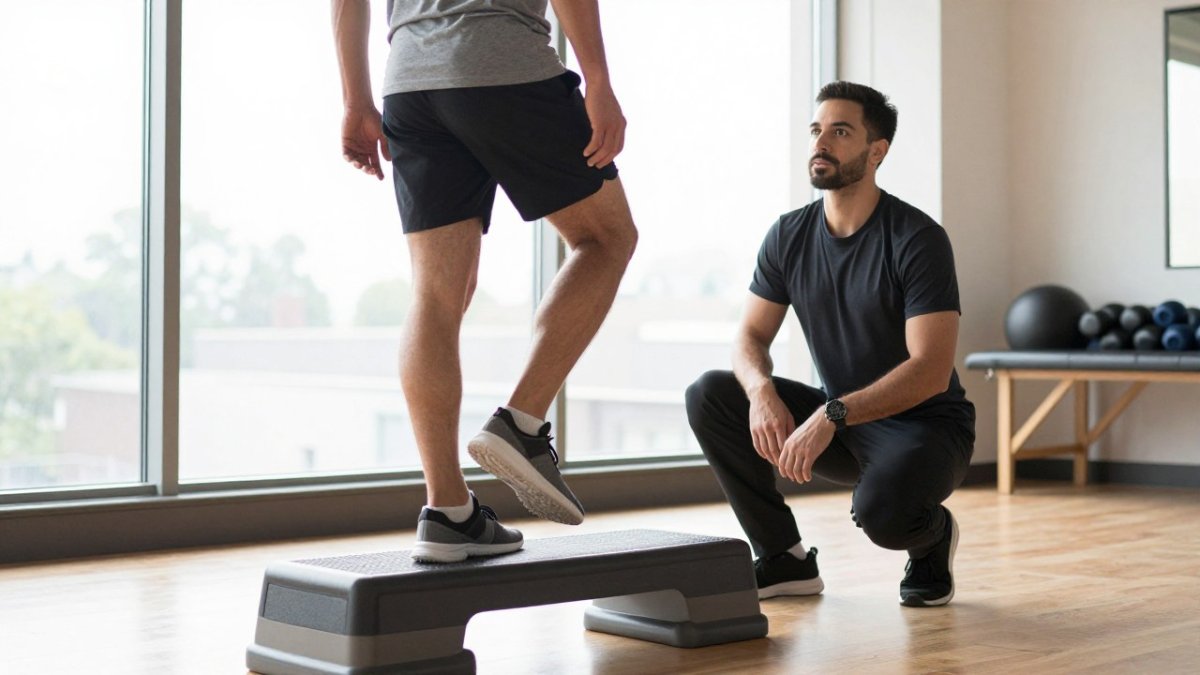
A practical progression:
- Isometric holds - contract the muscle without moving the joint, 30 to 45 seconds
- Slow eccentric work - lower the weight over 3 to 5 seconds
- Full range loading - add concentric and eccentric phases
- Heavier, slower sets - build strength with control
- Sport-specific loading - add speed and direction changes last
A common mistake is jumping from step one to step five. Tendons adapt slower than muscles. Expect weeks, not days.
Matching the Exercise to the Tendon
Generic loading advice fails because each tendon tolerates different stress. The table below shows the starting exercise most practitioners use for common sites, plus the load variable to progress first.
| Tendon | Starting exercise | First variable to progress |
|---|---|---|
| Achilles | Seated or standing heel raise | Add weight, then range |
| Patellar | Wall sit or leg press isometric | Add time under tension, then load |
| Elbow (lateral) | Wrist extension isometric | Add weight, then speed |
| Shoulder (rotator cuff) | Isometric external rotation | Add range, then resistance |
| Wrist (de Quervain) | Thumb isometric | Add gentle resistance |
Progress one variable at a time, load, range, speed, or volume, so you can tell what caused a flare.
Judging Acceptable Pain During Exercise
A common pattern is to stop at the first twinge, which stalls recovery, or to push through sharp pain, which worsens it. Most practitioners use a simple rule: mild discomfort up to about 3 out of 10 during exercise is acceptable if it settles within 24 hours and does not increase the next morning. Pain that climbs during the session, lingers past 24 hours, or wakes you at night means the load was too high.
Watch out: taking pain medication before a loading session can hide the feedback you need to judge whether the load was appropriate.
Load-Management Rules That Prevent Flares
- Increase load by no more than about 10% per week
- Keep one rest day between heavy loading sessions for the same tendon
- Track morning stiffness, a reliable early sign of overload
- Reduce volume first, not intensity, when symptoms climb
- Rebuild at the previous tolerated level before advancing again
If you are unsure how to load an injured area safely, our article on how to start training with injury walks through the process.
Natural Remedies for Tendonitis Inflammation Alongside Loading
Some adjunct measures may help people manage symptoms alongside loading. Loading is the component that drives tendon adaptation.
A published case study on chronic Achilles tendinopathy described a protocol combining heat, soft-tissue mobilization, eccentric exercise, stretching, and cryotherapy that appeared to support a rapid and complete recovery.
Adjunct options people ask us about:
- Ice after activity to calm irritation
- Heat before exercise to loosen tissue
- Soft-tissue massage to reduce muscle spasm
- Sleep and healthy eating to support tissue repair
For hands-on recovery support, you can view our recovery services and see what fits your plan.
Tendonitis How Long to Heal: Timelines and Stalled Recovery
Most chronic tendonitis cases take weeks to months to settle, not days. The exact timeline depends on severity, site, and how well you manage load. A useful way to think about it is in phases rather than a single date:
- Symptom control (roughly 1 to 3 weeks): reduce the activity that flares pain, keep gentle range of motion, and begin isometric loading
- Rebuilding capacity (roughly 4 to 12 weeks): progress eccentric and full-range loading, add strength work, and monitor 24-hour response
- Return to activity (often 3 to 6 months): reintroduce sport-specific speed and direction changes, then full training volume
These ranges are typical, not guaranteed. Tendons with a longer history of symptoms, or those in older adults, often sit at the longer end.
Why Recovery Stalls
When recovery stalls, the cause is usually one of these:
- Load increased too fast
- The wrong exercises for the injured site
- Pain masked with medication while training continued
- An underlying issue never assessed
A less obvious factor is adherence. A common pattern is to stop a loading program once symptoms ease, before the tendon has rebuilt capacity. The pain returns, and the cycle repeats.
How to Reassess a Stalled Plan
If progress flattens for several weeks, do not just rest harder. Work through a structured reassessment:
- Check the load log. Compare weekly volume and intensity against the 10% rule. A sudden jump is the most common cause.
- Confirm the exercise matches the site. A heel raise does little for a patellar tendon, and a wrist curl does little for a rotator cuff.
- Review the 24-hour response. Morning stiffness that is not improving suggests the load is still too high.
- Look at contributing factors. Factors such as sleep, stress, and certain medications are worth raising with a clinician.
- Ask whether the diagnosis is right. Persistent symptoms that do not respond to a well-run loading program are worth reviewing with a clinician, who can confirm or revise the diagnosis.
When Persistent Symptoms Warrant a Second Look
See a clinician if pain has not improved after 6 to 12 weeks of consistent, well-managed loading, if it is worsening despite reduced activity, or if you develop swelling, redness, or loss of function. Decisions about imaging or procedures are for a qualified clinician.
If you want help structuring a loading program and tracking your response, our guided training support can keep the plan on course.
When to See a Doctor for Persistent Tendon Pain
See a doctor if pain lasts more than a few weeks, worsens despite rest, or comes with swelling, redness, or loss of function. Seek prompt care for sudden severe pain, inability to bear weight, or a snap you felt during activity.
A clinical assessment can rule out other causes and confirm the diagnosis. Imaging or procedures such as injection or surgery are decisions for a qualified clinician, not something to self-direct.
Building a Recovery Plan With Guided Training Support
Guided training can reduce the guesswork in load management. Total Body Works Personal Training offers private, distraction-free personal training that can support a recovery plan.
Our approach includes:
- Distraction-free private personal training
- Active aging programs
- ARPwave and HBOT therapy
- Couples personal training
We do not diagnose or treat medical conditions. We coach safe loading and progress, and we suggest involving your clinician when needed.
To book an assessment or session, contact our team and we will map out your first steps.
Chronic tendonitis rarely resolves by waiting it out. It needs a plan built on progressive loading, honest pain monitoring, and steady adjustment. Total Body Works Personal Training offers private personal training, ARPwave therapy, and HBOT therapy to support that plan in a focused, one-on-one setting. Get started with Total Body Works Personal Training and build a recovery plan that moves at the pace your tendon can handle.
Frequently Asked Questions
Will chronic tendonitis ever go away?
Chronic tendonitis can improve, but it usually takes weeks to months of consistent loading rather than a single fix. Published guidance notes that early, specific rehabilitative exercise is beneficial and that appropriate tendon loading is critical for healing. Recovery depends on severity, how long the problem has been present, and whether you progress load gradually.
Should you rest or exercise when tendonitis gets worse?
Complete rest is rarely the full answer for chronic tendonitis. General medical guidance advises avoiding activities that increase pain or swelling and not working through pain, while noting that healing requires rest but not complete bed rest. Starting with a modified range of motion and progressing as strength and pain levels allow is a common approach. In practice, that means relative rest from the aggravating activity plus structured, progressive loading.
What exercises help with tendonitis?
Tendonitis exercises should load the tendon without pushing pain past a manageable level. One published case study described a protocol combining heat, soft-tissue mobilization, eccentric exercise, stretching, and cryotherapy. Eccentric and progressive strengthening work is the core. A qualified trainer or physical therapist can adjust range of motion, resistance, and volume to your specific tendon and stage of recovery.
When should you see a doctor for persistent tendon pain?
See a doctor if pain lasts more than a few weeks despite activity modification, if swelling or stiffness keeps worsening, or if you cannot perform daily tasks. A clinical assessment can confirm the diagnosis and rule out other causes. Persistent symptoms deserve professional evaluation.