 Ultimate guide
Can Personal Training Help Seniors With Parkinson's?
Last Updated: November 10, 2026
Quick Summary
Personal training can help seniors with Parkinson's disease when sessions are built around their symptoms, goals and energy levels. Private, supervised exercise that combines aerobic, strength, balance and flexibility work gives them structured support that a standard gym routine often lacks.
- Parkinson's Foundation guidance suggests aerobic exercise at least 3 days per week, for at least 30 minutes per session.
- Strength training at least 2 days per week is recommended, alongside flexibility and balance work.
- A two-year supervised study reported functional improvements with progressive resistance training in moderate Parkinson's.
- Sessions should be adjusted as symptoms change, and new falls or dizziness should be reported to the medical team promptly.
- Check with a physician before starting any new exercise program, especially with heart, lung or dizziness concerns.
Table of Contents
- How Exercise Supports People Living With Parkinson's Disease
- Exercise Types That Matter: Aerobic, Strength, Balance and Flexibility
- How Personal Training for Parkinson's Differs From a Standard Gym Routine
- A Sample Weekly Training Plan for an Older Adult
- Safety, Fall Prevention and Planning Around Medication Timing
- How to Choose and Vet a Parkinson's-Informed Personal Trainer
- Booking Your First Private Session at Total Body Works
- Frequently Asked Questions
How Exercise Supports People Living With Parkinson's Disease
Exercise is one of the few tools people with Parkinson's disease can use to influence how they move and feel day to day. At Total Body Works Personal Training, we work with older adults who want structured, private sessions that respect where they are today. The question many families ask is whether a trainer can make a real difference, and the answer depends on how the program is built and who builds it.
The Parkinson's Foundation recommends aerobic exercise at least 3 days per week, with at least 30 minutes of continuous activity per session (Parkinson's Foundation Parkinson's Exercise Guidelines, 2025). The same guidance covers strength training at least 2 days per week, along with flexibility and balance work. Exercise should always be adapted to the person's needs and abilities, so these numbers are starting points rather than fixed targets.
A two-year study of supervised, structured exercise reported that progressive resistance training and modified Fitness Counts improved functional performance in people with moderate Parkinson's disease (Two Year Exercise Program Improves Physical Function in Individuals With Parkinson's Disease). Consistent supervision over a long period is what the researchers highlighted, which is part of why private, regular sessions matter.
Exercise Types That Matter: Aerobic, Strength, Balance and Flexibility
A complete program rarely relies on one type of activity. Current Parkinson's exercise guidance covers aerobic work, strength training, flexibility, and neuromotor or functional training that includes balance, agility and multitasking (Parkinson's Foundation exercise guidelines, 2025).
One published exercise prescription suggests aerobic exercise three times per week, with a main set of 30 to 40 minutes at 60 to 80 percent of heart-rate reserve (The Universal Prescription for Parkinson's Disease: Exercise, 2020). These are published recommendations, not individualized targets, and a qualified professional should set the right intensity for each person.
Walking, stationary cycling and water-based activity are common aerobic choices. Balance and flexibility work matter just as much for older adults, because they support posture, gait and confidence on stairs and uneven ground.
The article breaks down the main exercise types and what each one contributes, as summarized below.
Exercise type | Example activities | Why it matters |
|---|---|---|
Aerobic | Walking, stationary cycling, water-based activity | Builds endurance at 60 to 80 percent of heart-rate reserve |
Strength | Resistance training, 2 days per week | Supports daily function and muscle strength |
Balance | Neuromotor and functional training | Supports posture, gait and confidence |
Flexibility | Stretching and mobility work | Supports posture and movement range |
How Personal Training for Parkinson's Differs From a Standard Gym Routine
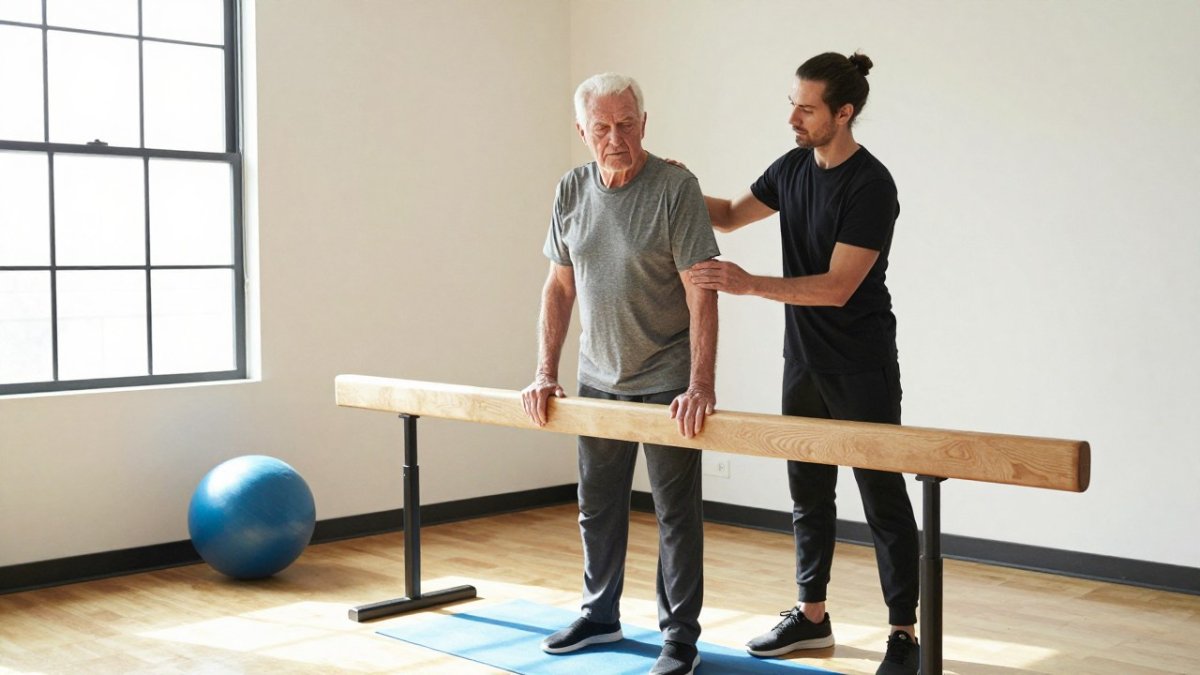
A standard gym routine is built around general fitness. A Parkinson's-informed session starts with a conversation about symptoms, medication timing, energy levels and goals. The trainer then chooses exercises, rest periods and cues that match the person's movement pattern.
Private, distraction-free sessions make it easier to pause, adjust and repeat a movement without feeling rushed. Our private format at Total Body Works Personal Training is designed for that kind of careful pacing.
Adapting Sessions to Stage and Symptom Profile
Two people with the same diagnosis can have very different needs. Someone with mild tremor may tolerate longer strength sets, while someone with significant balance problems needs seated or supported variations and more time between exercises. Sessions should be adjusted as symptoms change, and any new fall, dizziness or sudden drop in function should be reported to the person's medical team promptly.
A Sample Weekly Training Plan for an Older Adult
The following example shows how a private trainer might structure a week for an older adult with mild to moderate Parkinson's who is new to supervised exercise. It is an illustration, not a prescription, and a qualified professional should adapt volume, intensity and exercise selection to the individual.
Each supervised session runs about 45 to 60 minutes and follows the same arc: a 5- to 10-minute warm-up of walking, marching in place or seated cycling; a main block of 25 to 35 minutes; and a 5- to 10-minute cool-down of slow flexibility work for hips, shoulders, calves and the chest wall.
- Day 1 (supervised, aerobic and gait): 5 to 10 minutes of warm-up, then 20 to 30 minutes of walking on a treadmill with handrail support or seated cycling at a pace that allows conversation, then 5 to 10 minutes of cool-down. Add 5 minutes of heel-to-toe walking and wide turns near a wall.
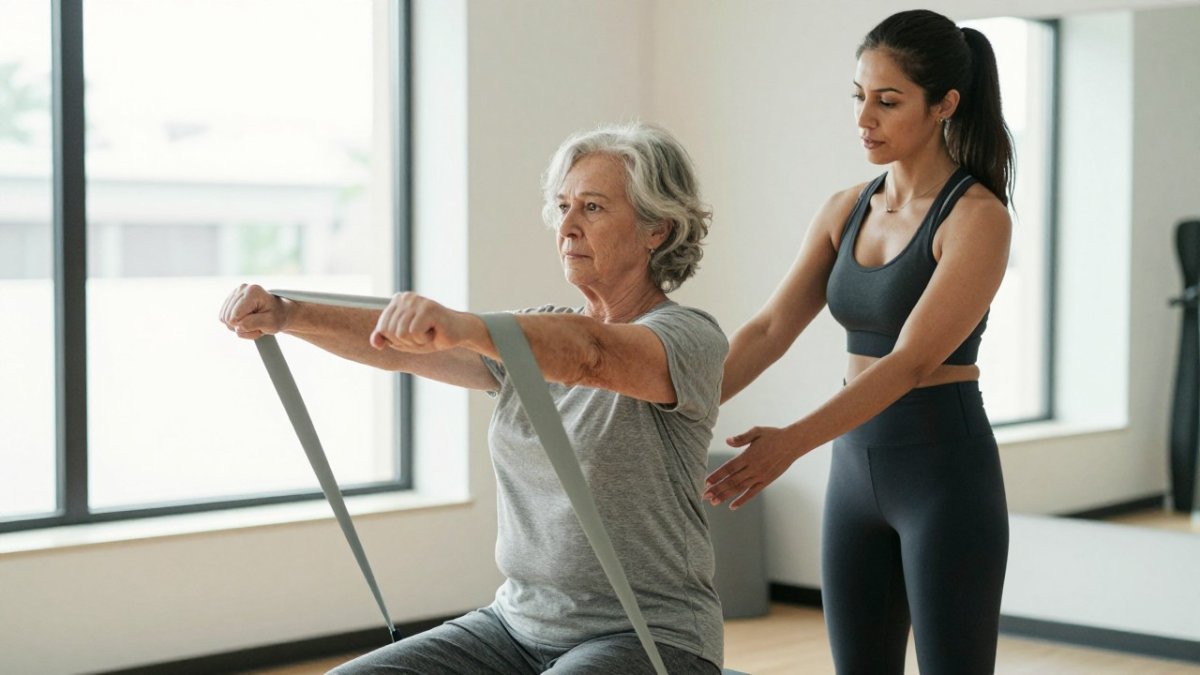
- Day 2 (home, strength): Sit-to-stand from a firm chair, 2 sets of 8 to 10; seated band rows, 2 sets of 10; supported calf raises, 2 sets of 10. Rest 60 to 90 seconds between sets.
- Day 3 (supervised, strength and balance): Supported squats to a chair, seated rows, light band chest press and step-ups with handrail support, 2 to 3 sets of 8 to 12 repetitions. Finish with 5 minutes of static balance practice, heel-to-toe stance, single-leg stance with counter support, and weight shifts.
- Day 4 (home, flexibility and recovery): 15 to 20 minutes of slow stretching for hips, hamstrings, shoulders and chest, plus deep-breathing practice. This is a lighter day by design.
- Day 5 (supervised, aerobic and functional): 20 to 30 minutes of stationary cycling or water-based activity, then 10 minutes of functional tasks such as carrying a light object across the room, turning in place, and stepping over a low marker.
- Day 6 (home, balance and coordination): Heel-to-toe walking along a counter, seated marching, and reaching tasks in standing with support. Keep total time under 25 minutes.
- Day 7 (rest): Recovery and ordinary daily movement.
Progression should be gradual. A common approach is to add 5 minutes to aerobic sessions or 1 to 2 repetitions to strength sets every one to two weeks, and only when the person finishes the prior week without unusual soreness or fatigue.
Sessions should shift as symptoms change. Someone with freezing episodes may need wider turns, visual cues such as a line on the floor, and more frequent rests. Someone with significant rigidity may do better with a longer warm-up and slower tempo. Someone with cognitive changes may need shorter blocks, one instruction at a time, and the same sequence each week.
Watch out: building a week around back-to-back hard days, or adding aerobic and strength progressions in the same week, is a common cause of overload and dropout in older clients. Progress one variable at a time.
Safety, Fall Prevention and Planning Around Medication Timing
Fall prevention is central to any plan for someone with Parkinson's. Sessions should include a stable setting, supportive equipment within reach, and clear instructions about when to stop. Many people find that exercise feels different depending on when they last took their medication, so it helps to note this in each session and share patterns with the prescribing clinician.
Watch out: scheduling a hard workout during a period of stiffness or slowness can increase the risk of a fall, so plan lighter sessions for those windows.
Every person should check with their physician before starting a new exercise program, especially if they have heart or lung conditions, dizziness or other health concerns.
How to Choose and Vet a Parkinson's-Informed Personal Trainer
Most trainers advertise experience with older adults; far fewer can describe how they actually program for Parkinson's. The difference matters because the condition changes balance, gait, reaction time and fatigue in ways that a standard senior-fitness certification does not address.
Credentials to look for. A current personal training certification from a recognized body is the baseline. The American Parkinson Disease Association lists a free 1.5-hour online course on Parkinson's and safe exercise-program design with a certificate, which is one example of the kind of training a serious trainer pursues (American Parkinson Disease Association exercise education).
Screening questions for the interview. Ask how the trainer assesses balance and gait before writing a program, how they adapt a session when a client arrives in an "off" period, how they handle freezing episodes, and what they do when a client reports a new fall or a sudden change in function.
Red flags. Be cautious with a trainer who promises to slow or reverse the disease, who has no plan for a fall during a session, who trains clients with Parkinson's only in large group classes with no individual assessment, or who cannot explain how they would modify an exercise for tremor, rigidity or fatigue.
The trial session. A first session should include a conversation about symptoms, medication timing, energy patterns and goals, followed by a movement screen and a short, supervised workout. Watch how the trainer cues, clear, one instruction at a time, with visual or verbal prompts as needed, and whether they adjust on the fly.
Questions to bring to the first meeting. What is your experience with Parkinson's specifically, and how many clients do you currently train with the condition? What assessments do you use, and how often do you repeat them? How do you record medication timing and on/off patterns?
At Total Body Works Personal Training, our private format is built around this kind of individualized assessment and ongoing adjustment, and our active aging training options explain how that differs from group classes. If balance is your main concern, our balance and fall prevention training guide covers the basics.
Booking Your First Private Session at Total Body Works
Your first step is a conversation about your goals, your history and any concerns about falls or medication timing. At Total Body Works Personal Training, we offer distraction-free private personal training, couples training and specialized therapy options, for adults who want focused, expert-led care. To find out whether a private session fits your needs, book a 1-hour private training session or call 7194140482.
Our private studio format suits older adults who want steady, personal attention, and active aging training options explain how that differs from group classes. If balance is your main concern, our balance and fall prevention training guide covers the basics.
Total Body Works Personal Training helps older adults build strength, balance and confidence through private, individualized sessions. Call 7194140482 to start a conversation about your goals.
Frequently Asked Questions
What activities are beneficial for people with Parkinson's disease?
The Parkinson's Foundation exercise guidelines recommend a mix of aerobic exercise, strength training, flexibility work and neuromotor or functional training that includes balance, agility and multitasking. Aerobic activity is recommended at least 3 days per week in sessions of at least 30 minutes, and strength training at least 2 days per week. Walking, stationary cycling, swimming and water aerobics are common choices. Because needs vary, a qualified professional can adapt these activities to a person's ability and symptoms before a program begins.
How often should seniors with Parkinson's exercise?
Parkinson's exercise guidance generally recommends regular aerobic exercise and strength training, but these are general recommendations rather than individualized targets. Anyone with heart or other health conditions should check the plan with their doctor first.
Can personal training help improve balance and gait in Parkinson's?
Balance and gait work is a core part of exercise guidance for Parkinson's, which includes balance, agility and multitasking training. Research on supervised, structured exercise has reported improvements in functional performance in some people with Parkinson's disease. Results vary by person, so progress should be tracked with a qualified trainer over time rather than assumed.
What should I look for in a trainer who works with Parkinson's clients?
Look for a trainer who asks about your medical history, medication timing and current symptoms before starting, and who adapts sessions as your condition changes. Ask about their experience working with older adults and people with neurological conditions, and whether they coordinate with your healthcare team. Some organizations offer education in Parkinson's-safe exercise design, which can be one sign of relevant training.