 ultimate-guide
Is Hyperbaric Oxygen Therapy Safe for Youth Athletes?
Last Updated: November 1, 2026
Quick Summary
Hyperbaric oxygen therapy is generally well tolerated in supervised clinical settings for youth athletes.
- A 2024 double-blind trial found one 1-hour session did not significantly affect recovery or performance in elite youth football players as with anyone looking into this treatment plan it is not a 1 and done process.
- A 2026 review reported adverse events were rare.
- Screen for contraindications like untreated pneumothorax, ear and sinus problems, and uncontrolled seizure disorder before any session.
- A safe, effective treatment that accelerates healing, reduces inflammation, and enhances your body's natural ability to recover.
Table of Contents
- How Hyperbaric Oxygen Therapy Works for Young Athletes
- What the Evidence Says About HBOT for Sports Injuries
- Hyperbaric Oxygen Therapy Risks Parents Should Know
- Hyperbaric Oxygen Therapy for Children: Safety Questions to Ask
- HBOT Recovery Time: What to Expect After Sessions
- Making the Decision With Your Youth Athlete's Clinician
- Discussing HBOT With a Qualified Provider
- Frequently Asked Questions
How Hyperbaric Oxygen Therapy Works for Young Athletes
Hyperbaric oxygen therapy is a treatment that exposes a person to pure oxygen inside a pressurized chamber, raising the amount of oxygen carried in the bloodstream.
Parents often ask about this therapy. The therapy is generally well tolerated, but the evidence for recovery and performance in young athletes has not been widely studied.
Inside the chamber, pressure rises above normal atmospheric pressure, measured in atmospheres absolute (ATA). That extra dissolved oxygen reaches tissue with poor blood flow, which is where the theory of faster healing and reduced inflammation comes from.
What Happens Inside a Pressurized Chamber
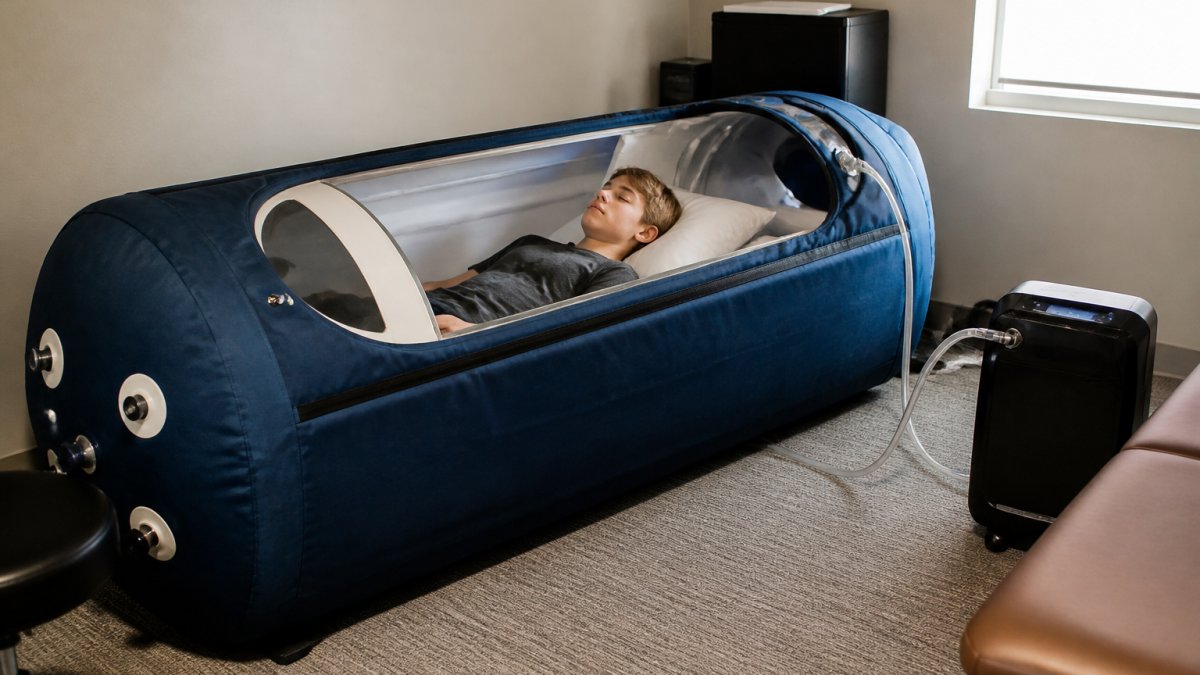
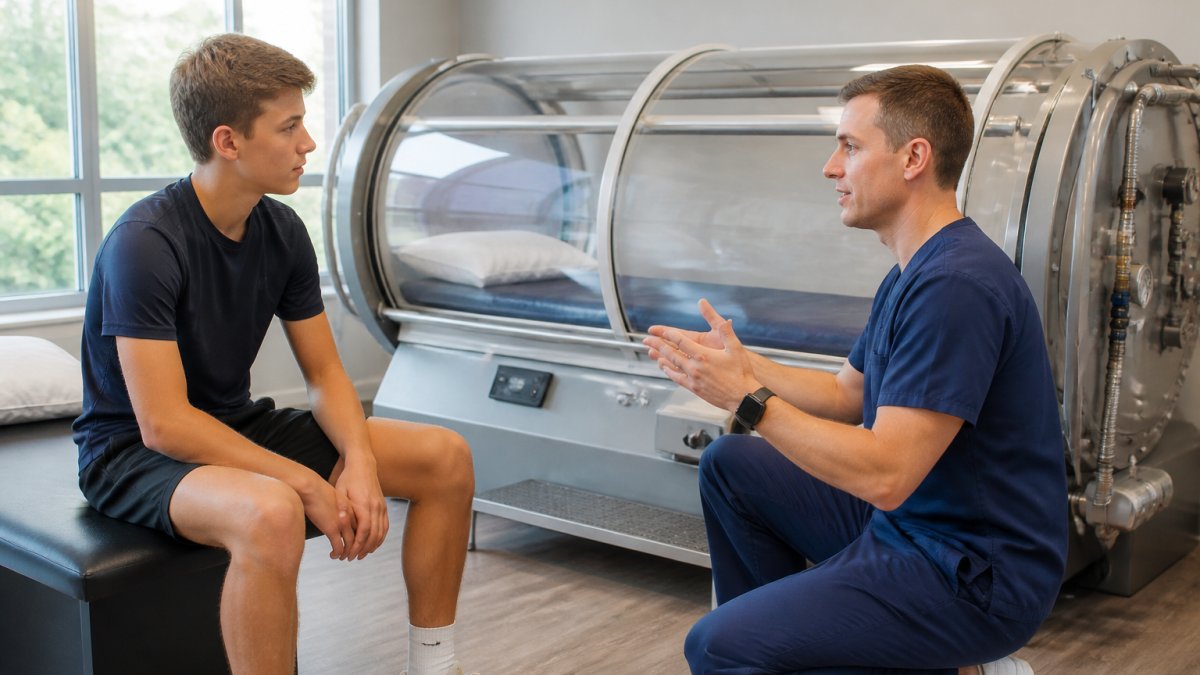
Most sessions involve lying or sitting in a clear or solid chamber while it pressurizes gradually. Patients feel pressure in the ears, similar to a flight descent, and are taught to equalize by swallowing or yawning. A clinician monitors the whole session, and oxygen flows continuously through a mask or hood. Nothing is painful, but equalizing comfortably is the main skill a young athlete needs to learn.
Typical Session Length and Frequency
Session length and frequency vary by provider and indication, so confirm any protocol with the treating clinician rather than treating it as universal. A common structure is roughly an hour per session across a series of visits. A published trial on young athletes used a single 1-hour session which is not enough for any study to make any conclusions, and is well known in the hyperbaric medicine therapy circles.
What the Evidence Says About HBOT for Sports Injuries
The strongest youth-specific evidence is modest, and parents should hear that plainly. A double-blind randomized controlled trial in elite youth football players found that a single 1-hour session did not significantly affect recovery or performance parameters after a match, according to the 2024 trial on HBOT and recovery in young players. Many studies point out that 10 or more treatments are necessary to move the needle in any significant way.
Broader reviews are more encouraging on safety than on performance. A 2026 review reported that adverse events were rare in the studies it assessed, according to the 2026 review of HBOT effects.
For a deeper look at how HBOT and ARPWave are used together for athletic recovery, see how ARPWave and HBOT support athlete recovery.
Hyperbaric Oxygen Therapy Risks Parents Should Know
Hyperbaric oxygen therapy risks fall into two buckets: the mechanical and the biological. For a youth athlete, the details matter more than the labels.
Mechanical Risks: Pressure and the Ear
The most common adverse event in clinical hyperbaric practice is middle-ear barotrauma, discomfort, muffled hearing, or fluid behind the eardrum from failure to equalize pressure. It is usually mild and resolves, but it is why a session is supervised rather than self-administered.
The practical safeguard is equalization skill. A young athlete should be taught to swallow, yawn, or use a Valsalva maneuver before pressurization and should be allowed to signal discomfort at any point.
Biological Risks: Oxygen Exposure in a Growing Body
The biological question is the one that matters more for young athletes. A 2005 review noted that increased tissue oxygen can pose a risk of oxidative DNA damage, according to the review of HBOT as an athletic adjunct.
Two other biological risks are worth naming. Central nervous system oxygen toxicity, visual changes, ringing in the ears, nausea, twitching, or a seizure, is rare at sports-recovery pressures but is why sessions are time-limited and supervised. Pulmonary oxygen toxicity is a concern mainly with prolonged or repeated high-dose exposure.
What the Evidence Says About Frequency
A double-blind randomized controlled trial in elite youth football players found that a single 1-hour session did not significantly affect recovery or performance parameters after a match, according to the 2024 trial on HBOT and recovery in young players.
A 2026 review reported that adverse events were rare and mild across the studies it assessed, according to the 2026 review of HBOT effects.
Treating a chamber session as a substitute for sleep, nutrition, and load management is a common mistake. No chamber fixes an already overloaded training schedule.
For a deeper look at how HBOT and ARPWave are used together for athletic recovery, see how ARPWave and HBOT support athlete recovery.
Hyperbaric Oxygen Therapy for Children: Safety Questions to Ask
Most published research on hyperbaric oxygen therapy and athletes concerns adults. Whether the same pressures, session lengths, and repetition schedules suit a growing body is largely unanswered in the sports-recovery literature. That does not make HBOT unsafe for young athletes by default, it means families and clinicians must ask sharper questions than the marketing invites.
Pediatric Contraindications and Cautions
Before any chamber session, a clinician should screen for conditions that make pressurization or high oxygen exposure risky. Common contraindications and cautions include:
- Untreated pneumothorax, a collapsed lung is an absolute contraindication because pressure changes can worsen it.
- Ear and sinus problems, active ear infection, a perforated eardrum, severe sinus congestion, or a recent ear surgery can make equalizing difficult and raise barotrauma risk.
- Certain lung conditions, some forms of chronic lung disease and blebs require clearance before pressurization.
This is not a complete list and not a substitute for a medical evaluation. It is the kind of screening a careful provider performs before the first session, not after.
Warning Signs During and After a Session
A supervised session should include clear stop rules. Parents and athletes should know what to watch for:
- Ear pain, muffled hearing, or a feeling of fullness that does not clear, the most common adverse event is middle-ear barotrauma, and it usually shows up as discomfort during descent or after the session.
- Nosebleed or sinus pressure, can indicate sinus barotrauma and should be reported before the next session.
- Short-lived vision changes, temporary nearsightedness is a recognized side effect of repeated oxygen exposure and usually resolves, but it should be documented.
Questions That Separate a Careful Provider From a Sales Pitch
When parents ask us about hyperbaric oxygen therapy for children, we point them to questions that go beyond the brochure:
- What is the specific indication being treated, and is it an approved use or an off-label one?
- Who supervises the session, and what is their training in pediatric hyperbaric medicine?
- What is the pressure and duration protocol, and why that protocol for this age and size?
- How does the provider screen for the contraindications above, and who reviews the screening?
- What warning signs would stop a session, and who makes that call?
- What is the plan if the athlete cannot equalize comfortably?
- How will improvement be measured, and at what point would the provider recommend stopping?
A provider who answers all seven without hesitation is worth listening to. One who deflects to "it's natural" or "it can't hurt" is not.
A careful provider screens for these contraindications and cautions before the first chamber session.
Contraindication or caution | Why it matters |
|---|---|
Untreated pneumothorax | Absolute contraindication; pressure changes can worsen it |
Ear and sinus problems | Active infection, perforated eardrum, or recent surgery raise barotrauma risk |
Certain lung conditions | Some chronic lung disease and blebs need clearance before pressurization |
Uncontrolled seizure disorder | High oxygen can lower the seizure threshold |
Pregnancy | Generally avoided unless indication is life-threatening and specialist-reviewed |
Claustrophobia or inability to equalize | Athlete should not be pressured to continue |
Recent chemotherapy with certain agents | Some drugs interact with oxygen exposure; oncology review required |
HBOT Recovery Time: What to Expect After Sessions
Recovery time after HBOT sessions is generally short, with mild aftereffects such as temporary fatigue or ear fullness that commonly resolve on their own.
The more important question is not how you feel an hour after the chamber, but whether the therapy actually changes the athlete's return-to-sport timeline.
If you want to see what other recovery options pair with HBOT, review our therapies and training services.
Making the Decision With Your Youth Athlete's Clinician
The right way to decide is not to search for a chamber and book it, but to bring the question to the clinician already managing the athlete's injury or training. That clinician knows the injury history, growth status, and competitive calendar, and can say whether HBOT fits an approved indication or is being used experimentally.
Bring three things to that conversation: the specific product or protocol being considered, the published evidence you have found, and a clear question about what outcome would justify continuing past the first few sessions. A clinician willing to say "let's try a short course and measure" is more useful than one who promises a result up front.
Discussing HBOT With a Qualified Provider
A good consultation should feel like an assessment, not a checkout. Expect questions about injury history, current medications, ear and sinus health, and training load.
Total Body Works Personal Training offers HBOT therapy alongside private personal training and ARPwave therapy. To see what is offered and how to start the conversation, visit https://www.totalbodyworkspersonaltraining.com/therapy
The hardest part of this decision is separating genuine clinical support from confident marketing. Start with the clinician who knows your athlete, ask the safety questions, and treat any promised timeline with skepticism.
Frequently Asked Questions
Is hyperbaric oxygen therapy safe for youth athletes?
Research suggests HBOT is generally well tolerated, with a 2026 review reporting rare and mild adverse events across assessed studies. However, that review was not specific to youth athletes, and a 2005 review notes that increased tissue oxygen can pose a risk of oxidative DNA damage. A 2024 trial in elite youth football players found no significant recovery or performance effect from a single one-hour session. Parents should treat HBOT as a decision to make with a physician who knows the athlete's health history.
What are the risks of hyperbaric oxygen therapy for children?
Hyperbaric oxygen therapy risks include potential oxidative stress from elevated tissue oxygen, which a 2005 review flags as a concern. The 2026 review found adverse events rare and mild, but it did not report youth-specific safety rates. Because children and adolescents may respond differently than adults, and because evidence in young athletes is limited, a clinician should review any conditions that could raise risk before a session is scheduled.
How long does an HBOT session last?
The youth-athlete trial published in 2024 used a single one-hour session, and that is a common format. Session length and frequency are set by the supervising clinician based on the reason for treatment and the athlete's health status. Ask the provider how long each session runs, how many are recommended, and what monitoring happens during treatment so you can plan around school and training schedules.
Can HBOT help a young athlete recover from an injury faster?
The evidence is mixed. A 2024 double-blind randomized controlled trial found that one one-hour session did not significantly affect recovery or performance parameters in elite youth football players. A 2026 review reports generally favorable safety data but notes serious-to-critical risk of bias in non-randomized studies. HBOT recovery time and effectiveness likely depend on injury type and protocol. Discuss realistic expectations with a sports medicine clinician before committing.
What should parents ask before considering HBOT for a young athlete?
Ask whether the provider is medically supervised, what conditions are being treated, and what the clinical evidence is for that specific use. Request the session length, pressure level, and monitoring plan. Ask about hyperbaric oxygen therapy risks for children, including any contraindications, and what warning signs to watch for afterward. Finally, confirm the provider coordinates with your athlete's physician so treatment fits the broader rehabilitation plan.