 blog
7 Best Strength Training Exercises for Knee Stability
Last Updated: November 2, 2026
Quick Summary
The best strength training exercises for knee stability are wall sits, straight-leg raises, glute bridges, step-ups, lateral band walks, split squats, reverse lunges, single-leg deadlifts and calf raises. Train two to three sessions per week, master bodyweight before adding bands or dumbbells, and build progress over months rather than days.
- Wall sits build quad strength without moving the joint; hold for 20 to 45 seconds.
- Strong glutes stop the knee from rolling inward during squats and runs.
- Step-ups expose side-to-side differences that double-leg exercises hide.
- Single-leg deadlifts train the hamstrings and balance at the same time.
- Keep discomfort at or below 3 out of 10 during exercise and rest 45 to 90 seconds between sets.
Table of Contents
- Why Strength Training Is the Foundation of Knee Stability
- 1. Wall Sits: The Isometric Builder for Quad Strength
- 2. Straight-Leg Raises: Low-Impact Quad Activation
- 3. Glute Bridges: Hip and Hamstring Support for Knee Control
- 4. Step-Ups and Lateral Walks: Single-Leg Stability in Action
- 5. Split Squats and Reverse Lunges: Controlled Knee Flexion
- 6. Single-Leg Deadlifts: Hamstring and Balance Training
- 7. Calf Raises: The Overlooked Ankle-Knee Connection
- How Often Should You Do Knee-Strengthening Exercises?
- Frequently Asked Questions
Why Strength Training Is the Foundation of Knee Stability
Knee stability is the ability of the muscles and connective tissue around your knee to control joint motion under load.
The research backs the approach. A 2025 review led by G. Zheng found that exercise interventions lasting more than 26 weeks produced the best results for preventing lower-limb injuries, according to the knee injury prevention review.
Four muscle groups do most of the work:
- Quadriceps control the knee as it bends
- Hamstrings slow the leg down and protect the joint
- Glutes and hip muscles keep the knee from caving inward
- Calves manage the ankle, which feeds directly into knee position
Most people train only the first group. That is a mistake. Weak hips and calves push extra stress onto the knee with every step.
If you want a program built for your body, our 1 hour personal training in Colorado Springs sessions give you a coach who watches every rep.
1. Wall Sits: The Isometric Builder for Quad Strength
Wall sits build quad strength without moving the joint. That makes them a smart starting point for anyone with knee pain.
Here is the setup:
- Stand with your back flat against a wall.
- Walk your feet out about a foot and a half.
- Slide down until your thighs are near parallel to the floor.
- Hold for 20 to 45 seconds.
Keep your knees stacked over your ankles. Sliding too low too soon is a common error. Start higher and add depth as you get stronger.
Do 3 to 4 holds per session, two or three times a week.
2. Straight-Leg Raises: Low-Impact Quad Activation
Straight-leg raises work the quad with almost no knee bend. They suit anyone coming off an injury or dealing with flare-ups.
A 2022 study led by U.H. Mitchell examined the quality of home knee-strengthening exercises, including straight-leg raises, and found that how well people perform these moves at home matters, per the home exercise quality study. Form is the whole point.
How to do it:
- Lie on your back with one knee bent and the other leg straight.
- Tighten the straight leg's quad and lift it to the height of the bent knee.
- Hold for 2 seconds, then lower slowly.
Keep your lower back flat. Do 10 to 15 reps per leg.
3. Glute Bridges: Hip and Hamstring Support for Knee Control
Glute bridges train the back of your body, which most knee programs ignore. Strong glutes stop the knee from rolling inward during squats and runs.
The movement:
- Lie on your back, knees bent, feet flat and hip-width apart.
- Squeeze your glutes and lift your hips until your body forms a straight line.
- Pause at the top for 2 seconds.
- Lower with control.
Do 12 to 15 reps for 3 sets. Add a band above your knees to make the glutes work harder.
4. Step-Ups and Lateral Walks: Single-Leg Stability in Action
Single-leg work is where knee stability gets tested. Step-ups and band walks train the hip muscles that keep your knee tracking straight, and they expose side-to-side differences that double-leg exercises hide. If one knee caves inward on a step-up but not on a squat, you have found the weak link.
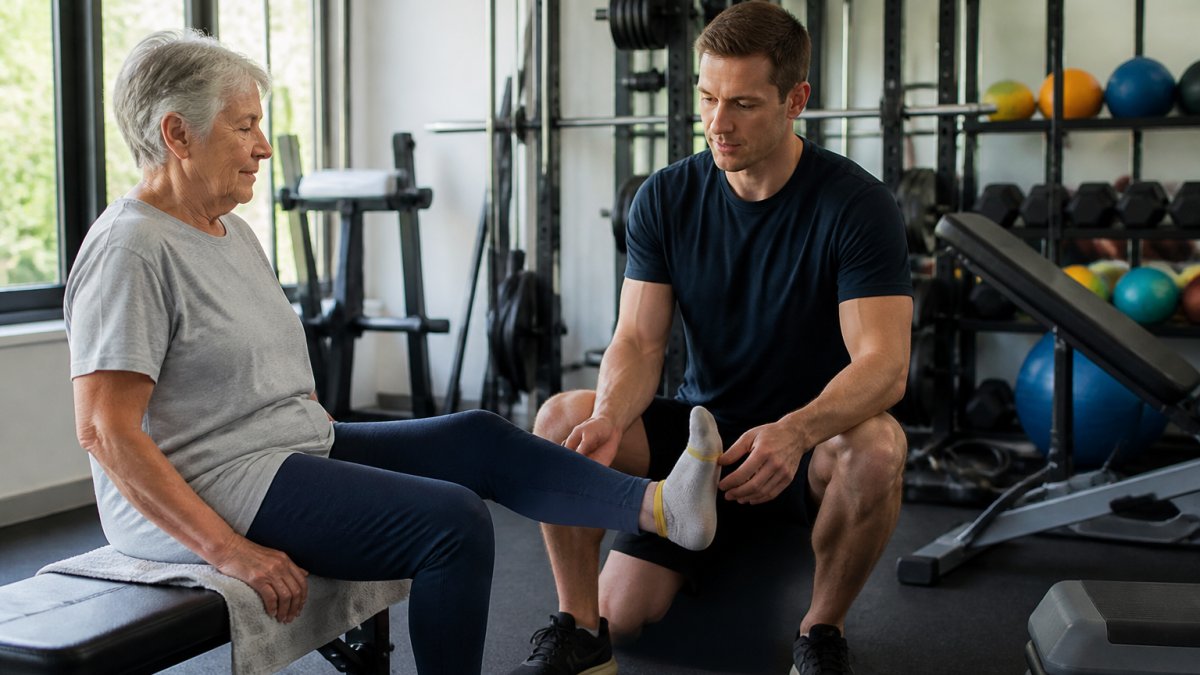
Person performing a step-up with resistance bands to improve knee stability in a training studio.
Step-Up Technique and Progressions
Start with a box low enough that your knee stays over your mid-foot at the bottom. Place one foot fully on top, drive through that heel, and stand tall. Lower slowly, about two seconds down, rather than dropping. Keep your knee from collapsing inward; if it does, the box is too high or the hip is too weak.
Do 8 to 10 reps per leg. Raise the box height only when you can complete all reps with a level pelvis and no inward knee drift. A common progression is bodyweight to a low box, then a higher box, then a dumbbell held at your side, then a contralateral dumbbell (opposite hand to the working leg) to challenge control further.
Common form errors to correct:
- Knee caving inward: Cue "push the knee out" and reduce box height.
- Pushing off the back foot: Keep the trailing foot light or hovering; drive only through the top leg.
- Torso collapsing forward: Keep ribs stacked over pelvis and eyes forward.
- Dropping down fast: Lower under control to build eccentric strength.
Regressions if the step-up is too hard: Start with a sit-to-stand from a chair, then a low step, then progress height. If balance is the limiter, hold a rail or doorframe with one hand until control improves.
Lateral Band Walks for Hip Abductor Strength
Loop a band above your knees (or around your ankles for a harder variation) and step sideways, keeping tension the whole way. Take 10 to 12 steps each direction. These target the hip muscles that control knee alignment, specifically the gluteus medius, which resists the knee rolling inward during single-leg stance.
Common form errors:
- Feet clicking together: Keep a shoulder-width gap throughout.
- Leaning away from the band: Stay upright; the band should pull you, not tip you.
- Short, choppy steps: Take controlled steps that maintain band tension.
Regression: Perform without a band, or with a lighter band, and focus on slow, deliberate steps. Progression: Move the band to the ankles, add a mini-squat hold, or increase band resistance.
For more single-leg work that reduces fall risk, see our guide to balance exercises for adults over 60.
5. Split Squats and Reverse Lunges: Controlled Knee Flexion
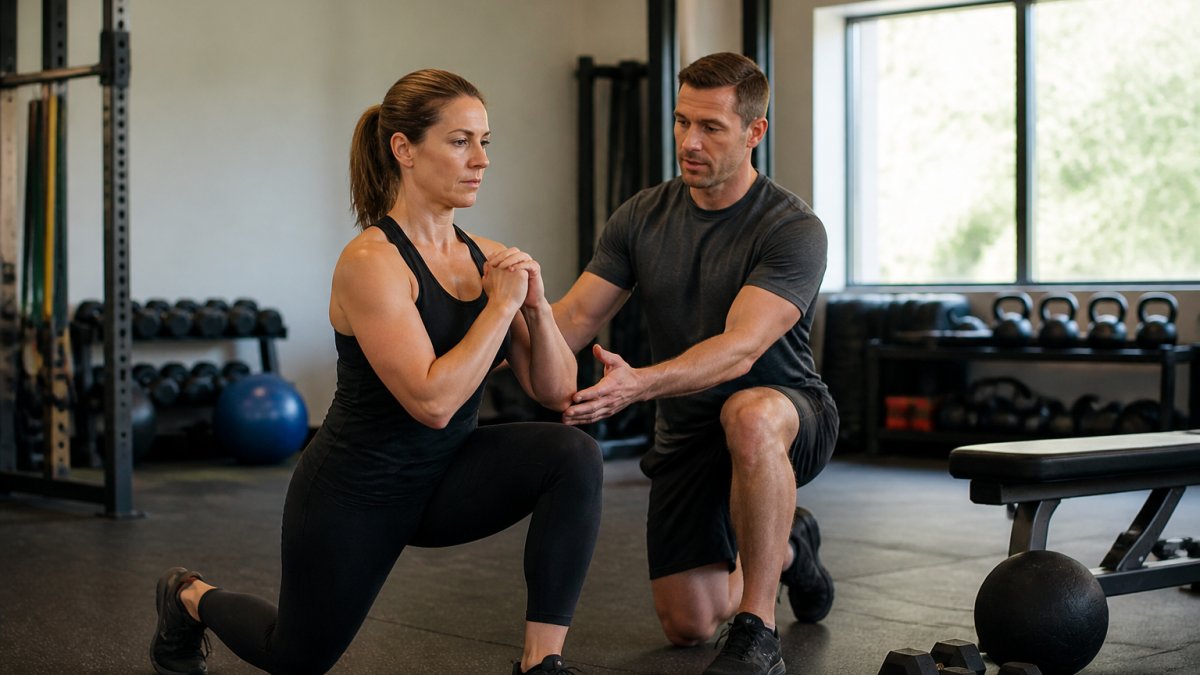
Split squats and reverse lunges load the knee through a full range of motion while keeping the front foot planted. That control is what carries over to stairs and hills.
The reverse lunge:
- Step back with one leg.
- Lower until both knees bend to about 90 degrees.
- Push through the front heel to stand.
Keep your torso upright and your front knee over your mid-foot. Do 8 to 12 reps per leg for 3 sets.
If knee pain shows up during these, our article on managing chronic pain with exercise covers how to train through it safely.
6. Single-Leg Deadlifts: Hamstring and Balance Training
Single-leg deadlifts train the hamstrings and balance at the same time. They are the best bridge between strength work and real-world stability.
How to do it:
- Stand on one leg with a slight knee bend.
- Hinge at the hips and reach the free leg back as your torso lowers.
- Keep your hips square to the floor.
- Return to standing with control.
Do 6 to 10 reps per leg. Hold a dumbbell once bodyweight feels easy.
Watch out: letting the standing knee lock straight removes the hamstring work. Keep a soft bend throughout.
7. Calf Raises: The Overlooked Ankle-Knee Connection
Calf raises seem too simple to matter. They matter. Your calf controls how your ankle moves, and your ankle position decides how much stress your knee takes.
Stand with feet hip-width apart and rise onto your toes. Pause at the top, then lower slowly. Do 15 to 20 reps for 3 sets. Add weight once that feels easy.
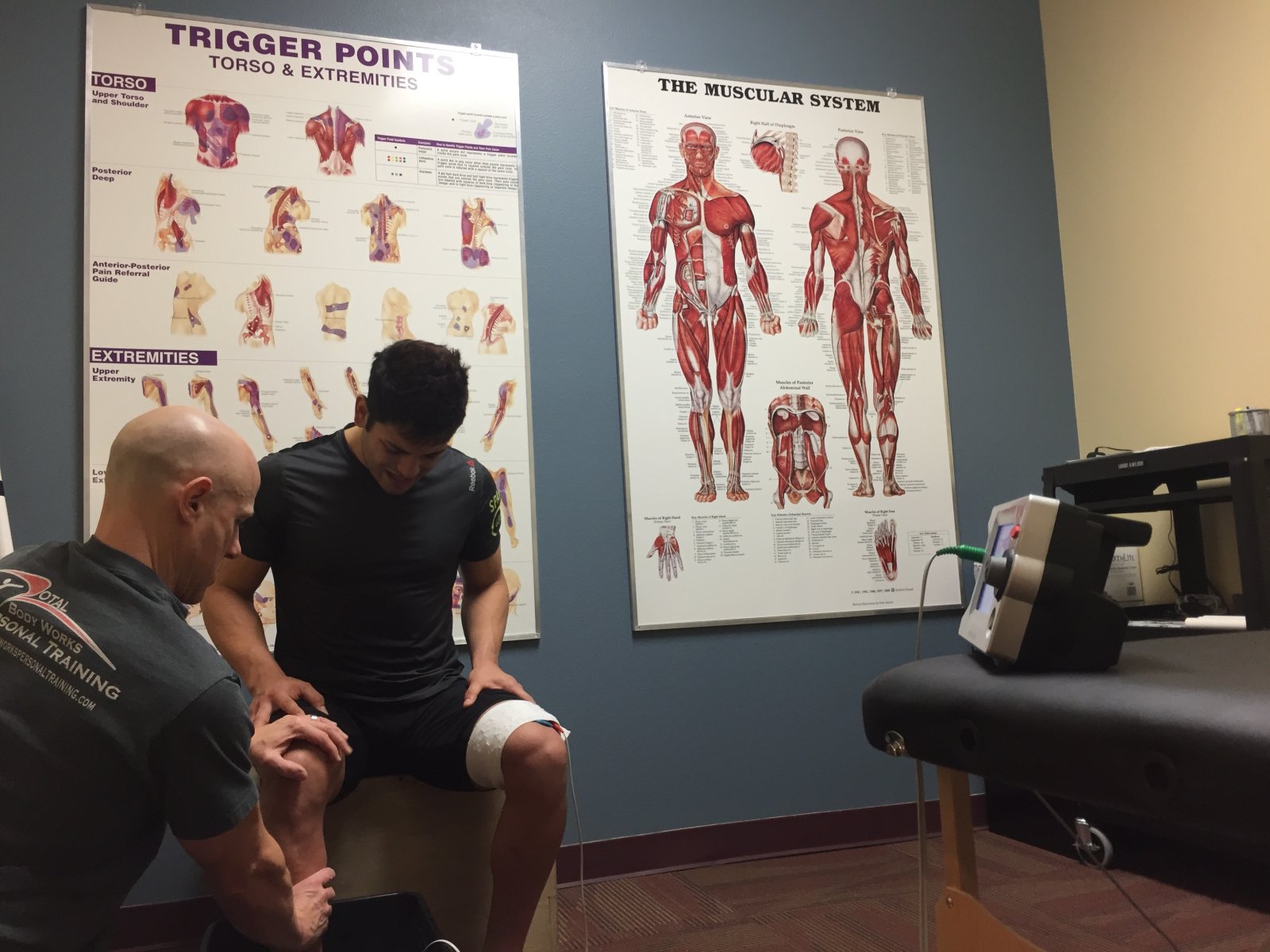
Pair calf work with recovery support, such as the therapies available through our therapy services.
How Often Should You Do Knee-Strengthening Exercises?
Two to three sessions per week is the standard starting point. Spread them out so your knees get a rest day between sessions. Most people do well with a full-body lower session twice weekly plus one lighter balance-focused day, rather than three hard days back-to-back.
Here is a simple weekly plan:
Day | Focus | Exercises | Sets and Reps | Rest Between Sets |
|---|---|---|---|---|
Monday | Quad and hip | Wall sits, glute bridges, step-ups | 3 sets each | 45-60 seconds |
Wednesday | Hamstring and balance | Single-leg deadlifts, reverse lunges | 3 sets of 8-12 | 60-90 seconds |
Friday | Full lower body | Split squats, calf raises, lateral walks | 3 sets each | 45-60 seconds |
Load and Progression Guidance
Build in this order: master bodyweight first, then add bands, then dumbbells. A practical rule is the "two-for-two" standard, when you can complete two extra reps beyond your target on two consecutive sessions with clean form, add resistance or difficulty. For isometric holds like wall sits, add 5-10 seconds before adding load.
Load should feel challenging but controlled on the last two reps of each set. If form breaks down before the target rep count, the load is too heavy. Rest 45-90 seconds between sets; longer rest (up to 2 minutes) for heavier single-leg work.
Pain and Safety Guidance
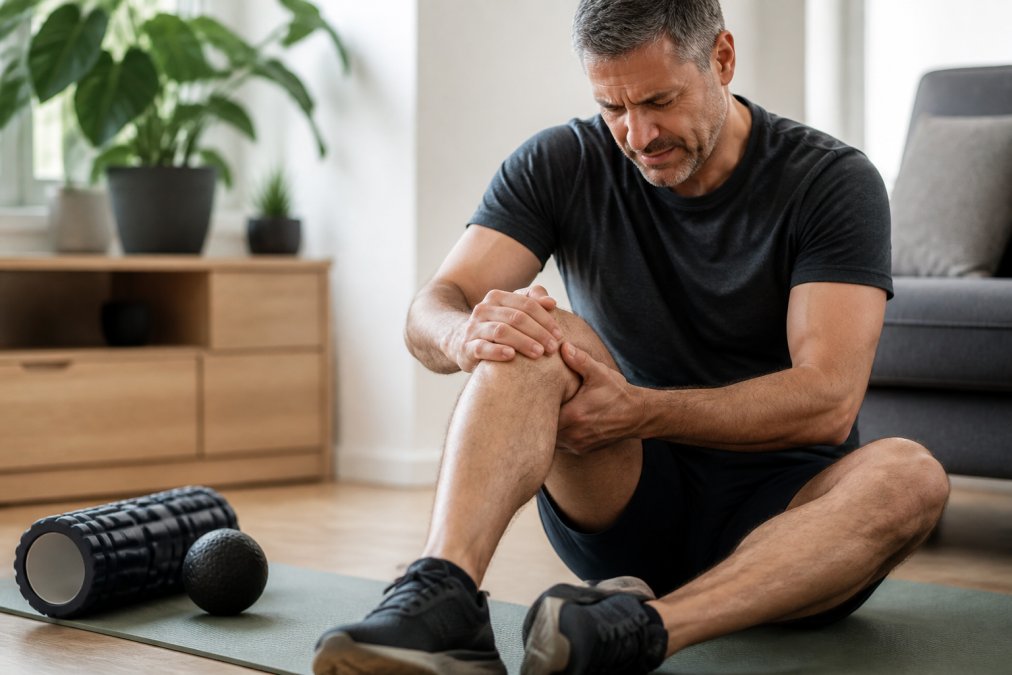
Mild muscle soreness that settles within 24-48 hours is normal. Sharp, pinching, or swelling pain during or after exercise is not, stop the movement and reassess. A useful guide is to keep discomfort at or below 3 out of 10 during exercise and to avoid any movement that produces catching, locking, or giving-way sensations.
Exercise Selection by Goal
General strength training and rehabilitation are not the same program. If you are returning from an injury, start with low-impact quad activation (straight-leg raises, wall sits at shallow depth) and progress range before load.
The 2025 review's 26-week finding is a useful guide. Expect steady progress over months, not days. Track one or two markers, such as wall-sit hold time or step-up box height, so progress is visible rather than assumed.
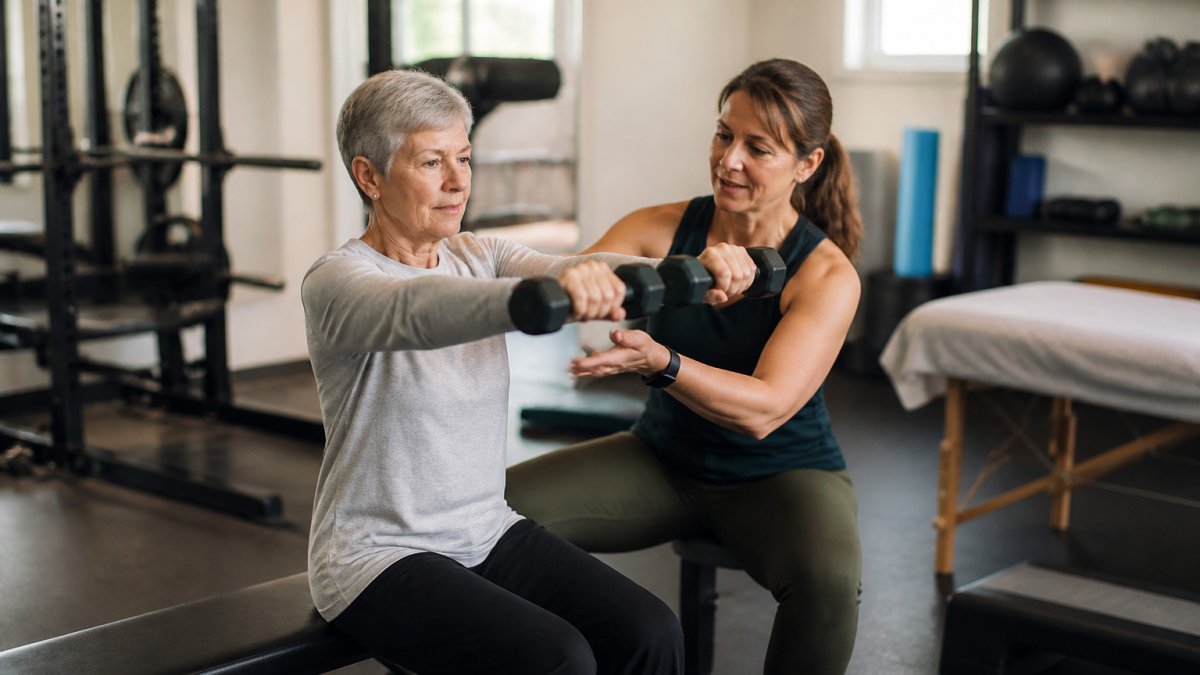
For older adults or anyone new to strength work, private coaching can make the ramp more manageable.
Frequently Asked Questions
What are the best strength exercises for knee stability?
Wall sits, straight-leg raises, glute bridges, step-ups, split squats, single-leg deadlifts, and calf raises target the quadriceps, glutes, hamstrings, and calves that control knee motion. Consistency over time generally matters more than any single movement. Start with bodyweight versions and add resistance bands or dumbbells as control improves.
How often should I do knee-strengthening exercises?
Aim for two to three sessions per week on non-consecutive days, which gives the muscles time to recover. Consistent programs over several months are generally a sound approach. If you are new to strength training or have knee pain, begin with two sessions per week and progress gradually. A physical therapist or trainer can adjust frequency for your specific situation.
Can strength training improve balance and knee stability as I get older?
Yes. Exercises like single-leg deadlifts, step-ups, and lateral band walks challenge balance while strengthening the hip and thigh muscles that stabilize the knee. For seniors, bodyweight or light-resistance versions are effective and low-impact. Home knee-strengthening exercises such as straight-leg raises and side-lying hip abduction can be done with light resistance or body weight. Progress slowly and use support if needed.
What exercises should I avoid with knee pain?
Avoid deep squats, high-impact jumping, and any movement that causes sharp pain or swelling. Instead, choose low-impact exercises for knee pain such as wall sits, straight-leg raises, glute bridges, and controlled step-ups. If pain persists or you have instability, see a physical therapist for an assessment. The best strength training exercises for knee stability are the ones you can do with proper form and without pain, so regress the movement rather than pushing through discomfort.
Knee stability does not come from one exercise. It comes from a plan that trains the quads, hamstrings, glutes, and calves together, week after week. That is what we build at Total Body Works Personal Training, with distraction-free private sessions, couples training, and recovery support through ARPwave and HBOT therapy. Get started with Total Body Works Personal Training and build a knee program that holds up for the long run. Call 7194140482 to schedule your first session.