 blog
Personal Training for Seniors in Colorado: 2026 Guide
Table of Contents
- What Personal Training for Seniors in Colorado Actually Involves
- Senior Strength Training: The Foundation for Independence
- Balance Exercises for Seniors That Reduce Fall Risk
- Mobility Training for Seniors: Moving Without Stiffness
- Why a Certified Older Adult Fitness Trainer Matters
- In-Home Training, Safety Screening, and Adapting to Health Conditions
- What Personal Training for Seniors Costs and How to Compare Options
- Frequently Asked Questions
Last Updated: October 4, 2026
What Personal Training for Seniors in Colorado Actually Involves
Personal training for seniors in Colorado is one-on-one or small-group coaching built around the physical realities of aging: preserving muscle, protecting joints, improving balance, and keeping you capable of the things you do every day. At Total Body Works Personal Training, we work with adults across the Pikes Peak region who want to stay independent, not just stay busy in a gym.
The first session rarely looks like a workout. It looks like a conversation and an assessment.
A trainer should ask about your health history, medications, past injuries, and what you actually want to do again. Maybe it is hiking a trail near Manitou Springs. Maybe it is getting off the floor without help. That answer shapes everything that follows.
- A movement and balance screen
- A strength and mobility baseline
- A plan you can progress week to week
- Clear checkpoints to measure improvement
The CDC's older adult physical activity guidance recommends that adults 65 and older get at least 150 minutes of moderate activity weekly, plus two days of muscle-strengthening work. Most people we meet are nowhere near that. The point of training is not to shame you into it. It is to build a realistic path there.
Senior Strength Training: The Foundation for Independence
Strength training is the single highest-value activity for older adults, because muscle is what lets you stand up, carry groceries, and catch yourself before a fall. It also supports bone density, which matters more every decade.
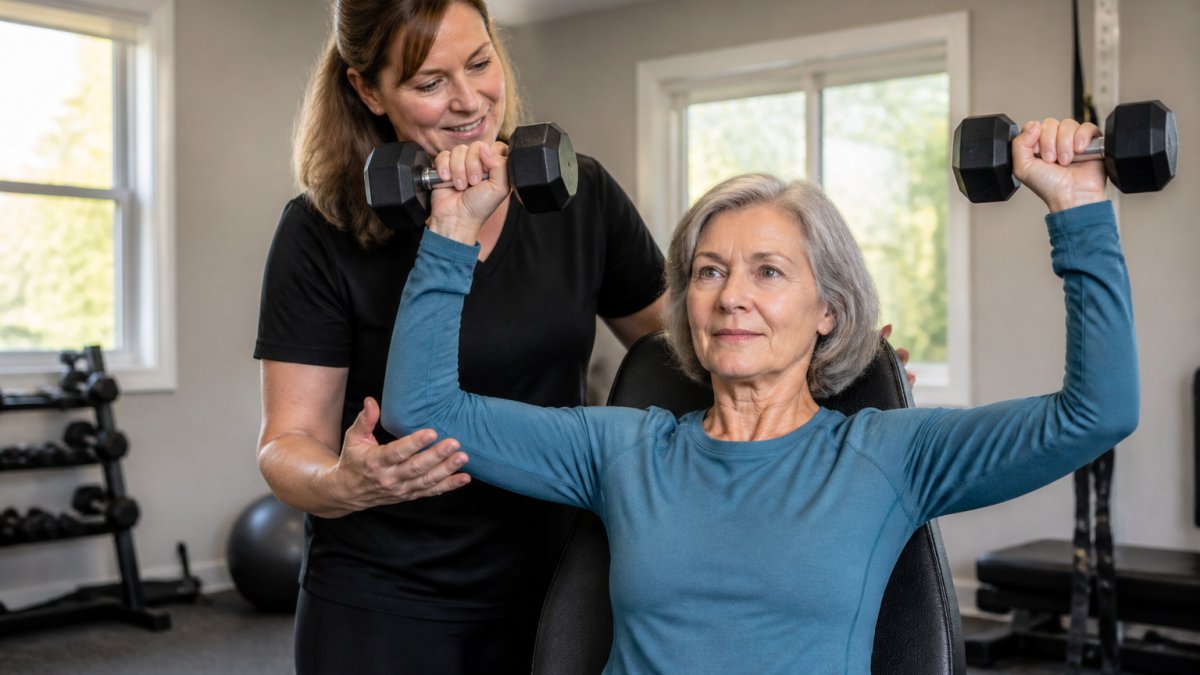
You do not need heavy weights to build muscle. You need progressive resistance and consistency. A common mistake is going too light forever, never adding challenge, and wondering why nothing changes.
Good senior strength training covers:
- Squat and sit-to-stand patterns for getting out of chairs
- Hinge patterns for lifting safely
- Push and pull for upper body function
- Carries and grip work for real-world tasks
Beginners often start with bodyweight, bands, or light dumbbells and add load every week or two. Certified trainers watch your form closely, because the goal is muscle building without joint irritation.
Balance Exercises for Seniors That Reduce Fall Risk
Balance work is fall prevention, and it deserves its own time in every session, not a few seconds at the end. Falls are the leading cause of injury for older adults, and balance is trainable at any age.
The National Institute on Aging's exercise and balance resources outlines how balance and strength work together to lower fall risk. In practice, we train three things:
- Static balance, like standing on one foot
- Dynamic balance, like walking heel to toe
- Reactive balance, like recovering when you are nudged
Start near a wall or counter for safety, then reduce your hand support as you improve. Single-leg stands, tandem walking, and controlled weight shifts are simple, effective, and easy to do at home.
What most guides miss is that balance declines quietly. You do not notice it until you stumble. Testing it regularly catches the change early, when it is still easy to fix.
Mobility Training for Seniors: Moving Without Stiffness
Mobility training keeps your joints moving through their full range so daily tasks stay comfortable. Flexibility and mobility are related but not identical: flexibility is muscle length, mobility is how well a joint moves under control.
Stiffness in the hips, shoulders, and ankles is what makes stairs, reaching, and getting dressed harder than they should be. A few focused minutes per session goes a long way.
- Hip and ankle mobility for walking and squatting
- Thoracic spine work for reaching overhead
- Shoulder mobility for dressing and carrying
- Gentle stretching after training, when muscles are warm
The gap most guides miss is that mobility is not just about stretching. It is about control at end range. A joint that can move but cannot be controlled at that end range is a joint waiting to get hurt.
A practical way to screen mobility before you train it:
- Sit-to-stand from a standard chair without using your hands. If you need your hands, hip and ankle mobility plus leg strength are limiting you.
- Reach both hands overhead against a wall without arching your low back. If your ribs flare, thoracic spine mobility is the bottleneck.
- Stand on one foot for 10 seconds with eyes open. If you cannot, ankle mobility and balance are both in play.
- Look over each shoulder while sitting tall. If one side is noticeably tighter, that asymmetry is worth addressing before it becomes a compensation pattern.
These are not diagnostic tests. They are practical checkpoints a trainer can repeat every four to six weeks to see whether the work is actually changing something. If the numbers do not move, the program needs to change.
Mobility work should feel like relief, not punishment. If a stretch hurts, you have gone too far. A common pattern is that people stretch aggressively for a few weeks, feel no better, and quit.
For older adults managing arthritis, neuropathy, or post-surgical limits, mobility training is not optional, it is the foundation that makes strength and balance work possible.
Why a Certified Older Adult Fitness Trainer Matters
A certified older adult fitness trainer has specific training in how aging bodies respond to exercise, which is different from coaching a college athlete. That distinction protects you.
Look for credentials from recognized bodies, and ask what continuing education the trainer holds in senior fitness. Experience with older adults matters as much as the certificate itself.
Questions worth asking before you book:
- What certification do you hold, and is it current?
- How many older adult clients do you train regularly?
- How do you screen for safety before starting?
- How do you adapt a session when something hurts?
A trainer who cannot answer these clearly is not the right fit, no matter how good the gym looks. Verification takes five minutes and prevents months of frustration.
In-Home Training, Safety Screening, and Adapting to Health Conditions
In-home training brings the session to you, which removes the two biggest barriers older adults report: transportation and intimidation. It also lets a trainer see the stairs, chairs, and floors you actually navigate.
Safety screening comes first. A responsible trainer asks about heart conditions, recent surgeries, blood pressure, balance diagnoses, and medications that affect dizziness or heart rate. When a health condition is present, the trainer coordinates the program around it and, where appropriate, asks you to check with your physician.
Adapting to health conditions is normal, not exceptional:
- Arthritis: lower impact, more range-of-motion work
- Neuropathy: balance focus and careful foot placement
- Post-surgery: gradual loading with clear limits
- Chronic pain: pacing and graded exposure
Total Body Works Personal Training uses a private, distraction-free setting in the Colorado Springs and Monument area, which suits clients who want focused coaching without a crowded floor. For clients managing ongoing pain or recovery, we also offer specialized therapies such as ARPwave and HBOT alongside training.
What Personal Training for Seniors Costs and How to Compare Options
Pricing for personal training for seniors varies widely by format, session length, and whether the trainer travels to you. Contact us directly for current pricing.
What you can compare is value per session, not just the sticker price. The table below shows what drives cost in each format so you can ask better questions before you commit.
| Format | Typical Setup | Best For | What Drives Cost |
|---|---|---|---|
| One-on-one studio | Private trainer, gym setting | Focused strength and balance work | Session length, trainer credentials |
| In-home training | Trainer travels to you | Limited mobility, no transport | Travel distance, equipment needs |
| Couples training | Two clients, one trainer | Partners training together | Shared session time |
| Group class | Multiple participants | Social motivation, lower cost | Class size, frequency |
| Hybrid therapy | Training plus recovery therapies | Chronic pain, injury recovery | Therapy type, session count |
A common pattern is that in-home sessions cost more per hour than studio sessions because the trainer loses travel and setup time. Group classes cost the least per person but offer the least individual attention. Couples training splits the cost of one trainer across two people, which can bring the per-person rate close to group pricing while keeping the session private.
What most cost guides skip is the fine print that actually changes your total spend:
- Cancellation policy: How much notice do you need to give? Is there a fee for late cancellation or no-show?
- Package expiration: Do sessions expire? Can you pause for travel, illness, or surgery?
- Reassessment cadence: How many sessions before the trainer formally reassesses your progress and adjusts the plan?
- Travel radius: For in-home training, is there a distance limit or a travel surcharge beyond a certain radius?
- Equipment: Does the trainer bring equipment, or do you need to own it?
- Insurance and liability: Is the trainer insured? Does the gym or in-home setup carry liability coverage?
The Medicare.gov guidance on preventive services notes that some preventive benefits may cover certain services, though personal training is generally not a covered benefit. Check your own plan for specifics. Some Medicare Advantage plans include fitness benefits through programs like SilverSneakers, which can offset the cost of group classes even if one-on-one training is not covered.
To compare providers fairly, ask each one the same five questions:
- What is the total cost per session, all fees included?
- How many sessions before we reassess progress?
- What happens if I need to pause or cancel?
- What certifications does my trainer hold?
- Is there a written plan I can see?
Frequently Asked Questions
How much does a personal trainer cost in Colorado?
Rates vary by provider, session length, format, and whether training happens in a studio or at home, so there is no single statewide figure. Private one-on-one sessions usually cost more than small-group options, and specialty services add to the total. Ask each provider directly for their current rates, package terms, and cancellation policy, and compare what is included rather than the headline number alone.
Can strength training help older adults maintain mobility and independence?
Yes. Regular strength training supports muscle mass, bone density, and the physical resilience needed for daily living activities like carrying groceries, climbing stairs, and getting up from a chair. Paired with balance and mobility work, it helps older adults stay active and confident. A certified trainer can build an individualized plan that starts at your current level and progresses safely. Book a fitness assessment to establish a baseline before starting.
What should seniors look for in a personal trainer?
Look for a certified older adult fitness trainer with experience training clients 50 and over. Ask about their certification body, how they screen for health conditions, and how they adapt exercises for joint pain or prior injuries. Check trainer reviews and ask whether they offer in-home training if transportation is a barrier. A good trainer will start with a fitness assessment and build an individualized plan rather than a generic routine.
Is in-home training a good option for seniors in Colorado?
In-home training removes transportation and weather barriers, which matters in Colorado where winter conditions can disrupt routines. It also lets the trainer use your own equipment and see how you move in your daily environment. Ask whether the trainer carries insurance, how they handle safety screening, and what equipment they bring. If you prefer a private studio, many providers offer that too.
Finding the right training program in Colorado comes down to one question: does the plan match your body, your goals, and your life right now? Total Body Works Personal Training builds private, individualized programs for older adults, with distraction-free one-on-one and couples sessions, active aging programs, and specialized recovery options like ARPwave and HBOT. Call 719-414-0482 to schedule your assessment and start building the strength, balance, and mobility that keep you independent.